Claims Evidence
Thermal Imaging Leak Detection London
Infrared is the most convincing looking evidence in this trade and the easiest to oversell. A camera records a temperature difference. It does not record a leak, and the distance between those two statements is where a claim file gets into trouble, because a loss adjuster who has seen one overstated image starts reading everything else sceptically.
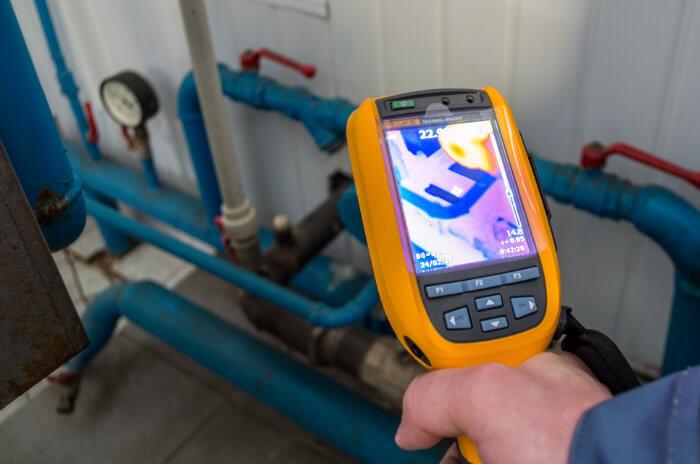
How thermal evidence carries on a claim
| Invoice line | How it is treated | When it is settled |
|---|---|---|
| Survey under working conditions | Detection line, fixed and agreed at booking | Heating run up first where relevant |
| Imagery paired with moisture readings | Included, because images alone get queried | Captured together, timed and located |
| Corroboration by a second method | Included where the anomaly is ambiguous | Same attendance |
| Statement of what the images do not show | Included, and it is what makes the rest credible | Written into the report |
| Opening up over the confirmed anomaly | Access line, justified from the paired evidence | Quoted after the survey |
Fee basis, not a quote, and not a statement of what your own policy covers. Our detection figure is fixed and confirmed in writing before anyone travels.
Used carefully the imagery does something no other method does: it shows the shape and extent of moisture across a surface, which is what the drying and reinstatement scope is eventually argued from. Used carelessly it turns a cold draught or a poorly insulated joist into a burst pipe. The discipline is in what gets written beside each image.
Every anomaly we photograph is paired with a moisture reading taken at an identified point, and where the pattern could have more than one cause the report names the alternatives and says which further test settled it. That is less dramatic than a single striking image. It is also the version that survives being assessed by somebody who was not standing in the room.
One fixed figure for the survey and the written findings, confirmed before attendance. The imagery, the paired moisture readings and the statement of limits are part of it, not an upgrade. Access, repair and reinstatement are quoted separately.
What you get
- Comprehensive digital report formatted for insurer review
- High-resolution thermal images annotated with temperature differentials
- Correlated moisture meter readings to substantiate findings
- Identification of leak source, not just symptom, for accurate repair scoping
- Non-invasive methodology that prevents unnecessary property damage
- Detailed logs of inspection areas and methodology for audit trails
How it works
A method, not a guess
01
Set the conditions before the camera comes out
Heating run up where the suspected circuit is heated, and the ambient state of the room recorded. An image taken on a cold system shows almost nothing, and a report that does not say what state the building was in cannot be interpreted later.
02
Survey the whole surface, not the complaint
Moisture rarely surfaces above the failure. Scanning the full floor and the adjoining rooms gives the spread rather than the symptom, which is what the eventual reinstatement scope has to be built on.
03
Pair every anomaly with a reading
A thermal pattern is corroborated by a moisture meter at a stated point, or it is recorded as uncorroborated. Images that stand alone are exactly the ones that come back with a request for further information.
04
Write the alternatives down
Cold bridging, a missing insulation batt, a draught and a leak can all look similar on a screen. The report names what else could produce the pattern and says what ruled those out, because that reasoning is what an adjuster is checking for.
Six ways thermal evidence gets weakened, and how to avoid them
An image with no reading beside it
A thermal camera records surface temperature. That is all it does. A warm band across a floor is consistent with a leaking heating pipe, and also with a heating pipe working normally, and also with a difference in floor construction. What turns the image into evidence is a moisture reading taken at a stated point within the same area, recorded at the same time. Reports that attach images to an invoice and leave them to speak for themselves are the ones that come back with requests for further information, and the request usually arrives weeks after anybody could still take the reading.
No record of the conditions
The same property photographed on a cold morning with the heating off and on a warm afternoon after two hours of heating produces two entirely different sets of images. If the report does not say which it was, nobody reading it later can interpret it. What should be recorded is whether the system was run up and for how long, the ambient conditions, and anything else that would change what the camera could see. It is one line, it costs nothing at the time, and without it a striking image is an undated photograph of a warm patch.
Presenting an anomaly as a conclusion
The most damaging sentence a thermal report can contain is one stating that the images show a leak at a given point, with nothing further. A loss adjuster who has previously seen cold bridging imaged as a burst pipe will treat that phrasing as a reason to scrutinise the whole document. The stronger form names what the pattern is consistent with, names the realistic alternatives, and says which further test discriminated between them. It reads as less certain and is taken more seriously, which is a trade most people accept once they have had a claim queried.
Silence about what infrared could not see
Cold water escaping under a cold floor may produce no usable differential at all, and a clear scan in those conditions is not evidence that a property is dry. A report that fails to say so effectively claims a negative result it never established. Where infrared cannot see the failure, the useful document says so, names the method used instead and reports what that found. Be wary of any contractor whose thermal reports never contain a limitation, because the limitation exists whether or not the report acknowledges it.
Surveying the complaint instead of the property
Moisture very rarely surfaces directly above the failure. It runs along joists, tracks under screed and appears wherever the construction lets it out, which is often a room away. A scan confined to the stained ceiling records the symptom and misses both the source and the true extent of the wetting. Since the drying scope and the reinstatement figure are argued from the extent rather than from the stain, a partial survey tends to understate the claim in the policyholder's own direction. Ask what area will be covered before agreeing a fee.
Images that cannot be placed
An image with no reference to a findable feature in the property could have been taken anywhere. That sounds pedantic until a file contains twelve of them and somebody has to work out which room each belongs to. The working standard is a timed image tied to something locatable, in a sequence covering the area before anything was touched, the access being taken, the failure visible in position, and the affected areas with an object in frame for scale. Ask to see a redacted example and judge the photography rather than the claims about it.
Compare like for like
Why infrared images get queried, and what stops that
Thermal imagery is the most persuasive looking evidence in leak detection and the easiest to overstate. A camera records a temperature difference. It does not record a leak. The gap between those two sentences is where claims get delayed, so here is what separates imagery that carries a file from imagery that merely decorates it.
| What to check | A one line invoice | A camera only firm | Emergency Leak Detection 247 |
|---|---|---|---|
| What the image is said to show | Usually nothing in writing at all. An image is attached to an invoice and left to speak for itself, which in an assessment it does not. | The anomaly is described as the leak. An adjuster who has seen a damp wall imaged as a burst pipe will treat that language as a reason to look harder. | The report states what the thermal pattern is consistent with and what else could produce it, then says which other evidence settled between them. |
| Corroboration | None. If the image is wrong there is nothing on file to catch it. | Rarely. The camera is the product, so a second method is an extra rather than part of the method. | Every anomaly is paired with moisture readings at identified points, and where it stays ambiguous a second technique is run before any conclusion is written. |
| Survey conditions | Whatever the conditions were on arrival. A cold system shows very little, and nothing on file records that. | Often better, though the conditions are seldom written into the report where an assessor can see them. | Heating is run up where relevant, and the conditions under which the images were taken are recorded alongside them, because conditions change what an image means. |
| Cold pattern leaks | Missed entirely. A cold water leak under a cold floor is close to invisible to infrared. | A known limitation, and a single method firm has no route past it beyond recommending another visit you pay for. | Where thermal cannot see the failure we say so and move to a method that can, inside the same fixed detection fee. |
| What the images are labelled with | Untimed and unplaced. An image that could have been taken anywhere weakens the parts of the file that are sound. | Usually timed. Location referencing is inconsistent, which matters when the adjuster is trying to place the anomaly in the property. | Each image is timed and referenced to something a stranger can find in the property, and the sequence covers before, during and after access. |
| How the fee reaches the claim | One figure for everything, which is the single commonest reason a settlement is sent back for itemisation. | A survey fee, separate, which is correct as far as it goes. | Detection, access, repair and reinstatement kept apart on the invoice so the covered lines can be paid without waiting on the uncovered ones. |
| Report addressed to whom | The person who paid. It then has to be explained by you to somebody who was not there. | The customer, with the technical detail pitched at a technical reader. | Written so a policyholder, a loss adjuster and a managing agent can each take what they need from it without a covering explanation. |
| Statement of limits | Absent. Certainty about something that could not have been established invites doubt about everything else. | Occasionally, though admitting what infrared could not settle sits awkwardly with selling infrared. | Where the imagery narrowed rather than decided, the report says which method decided, and where nothing decided, it says that too. |
What claimants ask
The questions policyholders and agents ask most
Thermal images turn up constantly in public discussion posts, usually attached to a question about whether the picture proves anything. The replies from people who have actually been through a claim are consistent and not especially flattering about infrared used on its own, and the reasoning behind them is worth understanding before you commission a survey.
Homeowners posting an image and asking what it shows
One of the most common discussions in the DIY and housing communities. Somebody uploads a thermal photograph from a contractor and asks whether it proves a leak, and the experienced replies almost always ask the same two things back: what were the conditions, and what did a moisture meter say in the same spot. Our take is that if the report cannot answer those two questions it has not really said anything, which is why every anomaly we record is paired with a reading at an identified point.
Claims stalled by an image that overstated itself
A pattern on the insurance discussions involves a report that described a thermal anomaly as a confirmed leak, an insurer who queried it, and then a second survey to establish what was actually there. The posters are usually annoyed with the insurer. The regulars usually point at the report. Our position is that a document which states what its evidence does and does not establish tends to be accepted faster than one which asserts more than it can support, even though it reads as less confident.
Disputes about how much of the floor was wet
Reinstatement arguments recur constantly, and they nearly always come down to whether the wet area was measured or estimated. Forum advice has settled on keeping a record of moisture readings at identified points with dates. Our take is that this is the single most useful thing thermal imaging contributes, since it maps spread across a surface in a way spot readings alone cannot, and the two together let a drying scope be argued from measurement rather than from appearance.
Confusion between damp and a plumbing leak
A steady stream of posts where a thermal survey found a cold damp area that turned out to be penetrating damp, condensation or a roof defect rather than escaping water. Regulars point out that policies treat those very differently and that some of them are not insured events at all. Our take is that a documented elimination is worth paying for in its own right, because a claim built on the wrong premise costs more to unwind than the survey that would have prevented it.
Arguments about whether the heating was on
A small but very consistent thread type where somebody suspects a survey was run on a cold system and therefore saw nothing. The advice that emerges is to ask beforehand how the property should be prepared. Our take is that the preparation is our responsibility rather than yours, and that the conditions belong in the report so that anybody reading it later can judge what the images were capable of showing in the first place.
Questions
Asked before every booking
An earlier contractor sent thermal images and my insurer asked for more. Why?
Almost always because the images arrived without anything attaching them to a conclusion. An assessor looking at a warm patch has no way of knowing whether it is escaping water, a heating pipe doing its job, or a difference in floor construction. What converts imagery into usable evidence is a moisture reading at a stated point in the same location, a note of the conditions the image was taken in, and a sentence saying what else the pattern could have been and why it was not.
Can thermal imaging find a cold water leak?
Sometimes, and far less reliably than a heating leak. Escaping cold water can cool a surface enough to show, but under a cold floor in an unheated room there may be no differential at all. Where that is the case we say the method was not able to see it rather than reporting a clear scan as a clear result, and we move to a technique that can within the same fee. A clear thermal scan is not evidence that a property is dry.
Does the report help with the drying and reinstatement scope?
That is often its most useful function. The imagery maps how far moisture has travelled through a floor or wall, and the paired readings give numbers at identified points. Between them they let a drying scope and a reinstatement figure be argued from measurement rather than from how a room looks, which matters because the visible staining is usually smaller than the wet area and occasionally much larger.
Will you say in writing if the survey found nothing?
Yes, with the conditions and the areas covered set out so the negative result means something. A documented clear survey redirects an investigation towards condensation, a roof or gutter defect, penetrating damp or a sealed system losing pressure through its own expansion vessel. Claims built on the wrong premise are more expensive to unwind than they are to prevent.
Do you attend with a loss adjuster present?
We can, where the adjuster wants to see the survey run. It is worth saying plainly that we are a detection and reporting contractor and are not instructed by your insurer. We record what we find, we do not decide what is covered, and we will not represent that a report obliges anyone to pay.
Do insurers accept thermal imaging as evidence?
As a recognised non destructive technique, yes, and with a qualification that matters: it is accepted as part of a body of evidence rather than as a standalone proof. What gets queried is not the method but the way findings are presented. Imagery paired with moisture readings, with conditions recorded and alternatives addressed, is treated as substantive. Imagery attached to an invoice with a one line conclusion tends to generate a request for further information, and by then the conditions have changed and the readings cannot be retaken.
Can thermal imaging see through walls and floors?
No, and any contractor implying otherwise is describing something the physics does not allow. A thermal camera reads the surface. What makes it useful is that a pipe behind plaster or under screed changes the surface temperature above it in a pattern, and that pattern is readable by somebody who knows what construction they are looking at. It is inference from surface behaviour, which is exactly why it needs corroboration before it turns into a conclusion in a report.
Will a thermal survey damage decoration or finishes?
The survey itself touches nothing. A camera is held at a distance and moisture readings are taken with pin free meters wherever the surface allows it. Where a pin reading is genuinely needed we ask first and take it somewhere inconspicuous. The invasive part of a leak investigation is the access to reach the failure, and the purpose of imaging before that is to make the access small enough that the reinstatement line stays defensible.
What does the report say if the images are inconclusive?
That they were inconclusive, along with why, and what was done instead. An unresolved anomaly recorded honestly is useful to whoever picks the investigation up next. An unresolved anomaly written up as a finding is a liability for everyone, including us, because the first thing that happens when it turns out to be wrong is that the rest of the document loses its credibility.
How should I prepare the property before a thermal survey?
Leave the heating in its normal state and tell us what that is, move what you reasonably can away from the walls and floors in the affected rooms, and avoid running hot water immediately beforehand in the area of interest. We will confirm anything specific when we book. The important part is that we know what state the building was in, because we record the conditions in the report and they change what the images can be taken to mean.
Can you attend with a loss adjuster or the managing agent?
Yes, and in a managed building it is often worth coordinating so nobody needs a second visit. It is worth being clear that we are instructed by whoever books us and we are not acting for your insurer. We record what we find and set out the evidence. Whether a claim is met is decided by your insurer against your wording, and we will not represent that a report obliges anybody to pay.
London-wide
Covering all 33 boroughs
Related services
UFH Leaks
UFH loops traced to centimetres in London properties using thermal imaging and tracer gas.
Learn moreHeating Leaks
Boiler losing pressure in a London home? We trace the heating leak before any floor comes up, then document cause and origin for your insurance claim.
Learn moreLeak Detection
Hidden leak in a London property? We locate it without demolition, then set out cause, origin and damage in a trace and access report for your insurer.
Learn moreWater going somewhere it shouldn’t?
Tell us the symptoms and your postcode. We’ll confirm the visit, the fixed detection fee and the arrival window before you commit to anything.
Book a detection visit