Claims Evidence
Acoustic Leak Detection London
Sound is the quickest way to settle where a pressurised leak is, and on its own it is the hardest kind of finding to defend on paper. Nobody else heard it. That is the problem an acoustic survey has to solve for a claim, and it is solved by writing down which reading came from which position while the equipment is still on the pipe.
How an acoustic survey is itemised on a claim
| Invoice line | How it is treated | When it is settled |
|---|---|---|
| Detection attendance and survey | Trace and access line, sits inside the schedule limit | Fixed and confirmed in writing before travel |
| Written findings and photographic record | Part of the detection line, never billed as an extra | Issued with the survey, not chased afterwards |
| Opening up to reach the confirmed point | Access line, justified against the acoustic finding | Quoted once the location is fixed |
| Repairing the failed section | Usually the policyholder's own cost, not an insured line | Quoted separately from detection |
| Making good after access | Reinstatement line, argued from the recorded justification | Priced once the extent of opening is known |
Fee basis, not a quote, and not a statement of what your own policy covers. Our detection figure is fixed and confirmed in writing before anyone travels.
So the survey is run to leave a trail. Contact points are referenced to something a stranger could find again, correlation results are recorded with the distance they returned, and anything that stayed inaudible is logged as inaudible rather than quietly left out. None of that adds time. It is simply the difference between a conclusion and an assertion.
We work across mains supplies, heating flow and return, and buried service runs in all 33 boroughs. If you are not claiming, you get a location and usually a repair. If a loss adjuster is going to read the file, you also get a document that holds together when somebody who was not present goes through it line by line.
The detection figure is fixed and confirmed in writing before anyone travels. It covers the survey and the written findings together. Opening up, repair to the failed section and making good are quoted as separate lines, because your policy treats them separately.
What you get
- Produces insurer-ready reports with time-stamped acoustic evidence and annotated floor plans.
- Non-invasive detection minimises further property damage, keeping claim costs controlled.
- Identifies leak sources in pressurised pipes for copper, plastic, and lead systems.
- Documents the precise investigative methodology required for Trace & Access validation.
- Helps establish a clear link between the leak location and necessary remedial works.
- Provides a professional statement of findings to support the claim submission.
How it works
A method, not a guess
01
Ask what the claim turns on
What is damaged, when it was first noticed, whether the insurer has been notified and whether pre authorisation is needed. A survey written for a live claim is scoped differently from a diagnostic one, and it costs nothing to know that before the van is loaded.
02
Reference every listening position
Each contact point is tied to something findable in the property before any reading is taken. A signal strength with no location attached to it is an anecdote, and an adjuster cannot do anything with an anecdote.
03
Correlate rather than estimate
Two sensors on the same run return a distance, not an impression. The figure the correlator produced is recorded as it was returned, along with the pipe material and length it was calculated against, because those assumptions are what an assessor will want to see.
04
Record the silence as well as the sound
Runs that produced nothing are logged with the position and the conditions, since a negative result is what clears a system. Those entries are unrecoverable once we have left, and they are the first thing asked for when a claim stalls.
Six things that decide whether an acoustic finding survives a claim
Was every listening position written down?
An acoustic conclusion rests entirely on readings nobody else was present for. That is fine, provided the file records where each contact point was, what it returned and in what conditions. Referenced to a fixed feature, a set of readings can be understood by somebody who was never in the room. Recorded as a single sentence saying a leak was heard under the hallway, it is an opinion, and opinions are what generate requests for further information. Ask a contractor before booking whether their report lists positions or just conclusions. The answer tells you a great deal about how the file will read in six weeks.
Does the correlation figure appear, with its assumptions?
A correlator returns a distance, and that distance is calculated against an assumed pipe material, diameter and run length. Change the assumption and the answer moves. A report that quotes the result without the inputs is asking to be taken on trust at exactly the point where trust is least useful. What you want to see is the returned figure, the material and length it was calculated against, and, where those were estimated rather than known, a line saying so. That single sentence is the difference between a number an assessor can check and a number they have to accept.
What happened on the runs that stayed silent?
Silence is a finding and it is the one most often left out, because it feels like nothing happened. It is also the first thing asked for when a leak turns up somewhere the survey said nothing about. A run tested and found quiet, logged with its position and the conditions, is a cleared run. The same run omitted from the report is an open question that can only be closed by returning to the property. Since the recording costs nothing at the time and cannot be recreated afterwards, treat its absence as a reason to choose someone else.
Is the material limitation stated honestly?
Acoustic detection works brilliantly on metal and struggles on plastic, which absorbs the frequencies the method depends on. Any competent operator knows this. Not every report says it. A quiet result on a plastic run is not evidence that the run is sound, and a document that presents it as one has a hole in it that a loss adjuster may well find before you do. The reports that hold up are the ones that say which sections the method could speak to and which it could not, then name what was used instead.
Did anything else confirm the point before the floor came up?
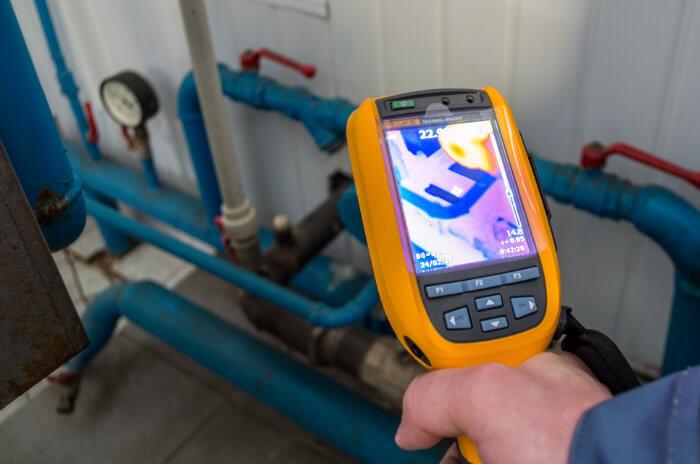
Trace and access lines are assessed on whether the opening up was reasonable in light of what was known at the time. One method agreeing with itself is thinner support for that than two methods agreeing with each other. Where acoustic findings are confirmed by tracer gas, thermal imaging or moisture readings before anything is lifted, the access decision has independent backing. Where they are not, the whole justification rests on a signal that only the engineer heard, which is a weaker place for an expensive reinstatement figure to stand.
Who is the document written for?
Most reports are written for the person who paid, which means you end up explaining them to a loss adjuster or a managing agent who was not there. Every explanation you have to supply is another thing that can be disputed. A report that works is one that can be forwarded unaltered and understood cold: plain language for the mechanism, references a stranger can locate, and an explicit statement of what the evidence does not establish. Ask to see a redacted example before booking and judge that rather than the promises around it.
Compare like for like
What an acoustic survey has to prove, not just find
Sound will tell a competent operator where a pressurised leak is. Whether a claim can be settled on that finding is a different question, and it turns on what was written down at the time. These are the checks a loss adjuster applies to an acoustic survey, and how three ways of buying one hold up against them.
| What to check | A one line invoice | A detection only firm | Emergency Leak Detection 247 |
|---|---|---|---|
| Method attached to the finding | The invoice says a leak was located. Nothing states how, so the conclusion reads as an assertion and gets returned for clarification. | Usually stated, because the method is what they sell. The weakness is elsewhere, in what happens after the location is marked. | Every finding in the report names the technique that produced it, so an adjuster can follow the reasoning without having been in the room. |
| What was eliminated | Not recorded. When the leak reappears in a different system, there is nothing on file to show that system was ever tested. | Sometimes noted informally. Rarely logged with the test that produced each negative result. | Each supply, heating circuit and waste run is logged with the test applied and the outcome, because a negative result you cannot evidence is worth nothing later. |
| Justification for the opening up | Written after the event, for the invoice. That is precisely the sequence an adjuster is alert to. | Often absent, because they hand over at the marked point and someone else opens the floor. | The state of knowledge at the moment the decision was taken is recorded in writing with the photographs, while the opening is still open. |
| Behaviour on plastic pipe | Plastic deadens leak noise. A listen only visit on plastic frequently ends in a guess that the file then has to carry. | The structural weakness of the single method approach, and it shows up exactly where the property is hardest to survey. | Where plastic mutes the signal we cross confirm with tracer gas or thermal before anything is committed to paper. |
| How the fee reaches the claim | One figure covering detection, access and repair together. Insurers cannot pay the covered part of a bundled line, so they query all of it. | A detection fee only, which is clean, but leaves you to reconcile it with a separate repair invoice that may not describe the same failure. | Detection, access, repair and reinstatement are quoted and invoiced as separate lines, because the policy treats them separately. |
| Who the report is written for | Nobody in particular. It is a job sheet that happens to get forwarded. | The customer. Fine for deciding what to do next, less useful when a third party has to assess it cold. | Written on the assumption that a stranger will read it six weeks later and has to reach the same conclusion from what is on the page. |
| Honesty about limits | No qualifications, which reads as confidence and is treated as overreach. | Varies. A method specialist can be reluctant to say where their own method stopped being conclusive. | Where a run was narrowed rather than pinpointed, or a circuit could not be fully tested, the report says so. That is what makes the rest of it credible. |
What claimants ask
The questions policyholders and agents ask most
Read the insurance public discussion of DIY and housing leak problems and a clear pattern shows up. The arguments that go on longest are almost never about equipment. They are about who carries which cost, what the paperwork needed to show, and the things nobody thought to write down while the floor was still open.
Posts where the insurer accepted the leak but queried the invoice
A recurring thread shape on the insurance discussions: nobody disputes there was a leak, and the claim still sits for weeks. Almost always the invoice showed one figure covering detection, opening up and a repair, and the insurer cannot pay the covered part of a line that also contains an uncovered part. Our position is that itemising takes minutes at the point of invoicing and weeks to fix afterwards, so we separate detection, access, repair and reinstatement by default rather than on request.
Confusion about what an acoustic survey actually promises
Posters frequently arrive expecting that acoustic detection either finds the leak or is free, and discover the contractor's definition of finding it was narrower than theirs. The replies usually land on the same advice, which is to get the scope in writing first. Our take is the same, with one addition: ask what happens if the method turns out to be inconclusive on your pipe material, because on plastic that is a realistic outcome and it is better priced before the visit than argued after it.
The recurring argument about how much floor had to come up
Threads where a reinstatement figure is challenged tend to turn on one question, which is what was known when the decision to open up was taken. Forum regulars increasingly tell posters to ask for the survey findings that preceded the access. Our view is that this is the single most useful thing a homeowner can insist on, and the reason we cross confirm with a second method and write the justification while the opening is still visible rather than reconstructing it for the invoice.
Quotes for the same job spread across an implausible range
Cost discussions routinely show quotes for one suspected leak varying by an order of magnitude, which broadly matches the spread Checkatrade publishes for UK leak detection, from eighty pounds to sixteen hundred pounds with an average nearer one hundred and sixty two pounds. Regulars point out that the cheapest attendance is often the one that finds nothing and recommends another visit. Our take is to compare confirmed total figures for a defined survey rather than headline hourly rates, since only a fixed figure can be held to.
People discovering their extension had a limit they never read
A steady stream of posts from homeowners who commissioned detection believing trace and access would meet it, then found a limit in their schedule far below the invoice, or found the extension did not attach because no damage had occurred yet. The public discussion consensus is blunt, which is to read the schedule first. We agree to the point of asking you to check the limit and the excess before booking, because it occasionally changes what you should instruct us to do.
Questions
Asked before every booking
Why does the report say where the sound was strongest rather than where the leak is?
Because that is what the instrument established, and a report that overstates its own evidence is the kind that generates questions. Where correlation and a second method agree on a point, the report says the failure is at that point. Where the signal narrowed a run without fixing a spot, it says the run was narrowed and names what would settle it. An adjuster reading the second version can still act on it. An adjuster who later finds the first version was a guess will look harder at everything else in the file.
Will an insurer accept acoustic findings on their own?
Often, where the finding is attributed to a method and the access taken afterwards matches it. Problems arise when an acoustic conclusion is presented without the positions it came from, or when a floor was opened somewhere the survey never pointed at. What we do to avoid that is cross confirm with a second technique before anything is lifted, so the access line is supported by two independent findings rather than one.
The pipework here is plastic. Does that change what the report can say?
Yes, and the report says so. Plastic absorbs the frequencies acoustic equipment relies on, so a quiet result on plastic is not evidence that the run is sound. Where we cannot get a usable signal we record that the method was inconclusive on that material and move to tracer gas or thermal within the same fixed fee. Leaving a limitation unstated is what makes the rest of a document look unreliable.
Who should the report be addressed to?
Tell us at booking and we will address it accordingly. In practice it is read by up to three people: you, the loss adjuster handling the claim, and in a flat or a managed building the managing agent or block insurer. We write it so all three can use it without a covering explanation from you, because every explanation you have to add is another thing that can be disputed.
Does a survey cover the cost of the repair as well?
No, and the two should not appear on the same line. A trace and access extension is generally written to meet the cost of locating the leak and of opening up and making good to reach it. The failed pipe itself is usually your own cost, and the damage the water caused sits under a different part of the policy with its own excess. We invoice those separately so the covered elements can be settled without waiting on the uncovered ones.
What should an acoustic leak detection report contain for an insurer?
The mechanism of failure rather than just a location, the position referenced to something a stranger can find, the listening positions and what each returned, any correlation figure with the assumptions it was calculated against, a record of the runs tested and cleared, dated photographs covering the area before access and the failure in position, and an explicit statement of what the evidence does not establish. A document containing those can be assessed on paper. One without them produces questions, and the questions are the delay.
Can acoustic detection find a leak in a block of flats?
Often, though a block adds a problem a house does not have, which is that the water may have travelled between demises before it appeared. Locating the failure is only half of what the file needs. It also needs to say which side of the demise the failed pipe sits on, because that decides whether the block policy, the leaseholder's policy or somebody's own pocket carries the cost. We record the configuration and where the failure falls within it.
How long does an acoustic survey take?
Two to four hours suits most London domestic properties. A single accessible run with a strong signal resolves faster. Buried supply pipes, long heating circuits and properties with high background noise take longer, and noise is a genuine constraint, which is why quieter periods sometimes produce a cleaner result. Where a second visit is genuinely needed we say so on the day rather than issuing a conclusion the readings do not support.
Is acoustic detection non invasive?
The survey itself is. Sensors sit on pipework, fittings and floor surfaces and nothing is opened to carry it out. Something usually still has to be opened to reach and repair the failure, and that opening is the part your trace and access extension is most likely to be assessed on. The point of surveying first is not to avoid opening anything. It is to make the opening small and to give it a written justification.
What if the survey cannot find the leak?
Where we attend a confirmed live loss and cannot locate it using the methods available, the detection fee is waived and you keep the full record of what was tested and cleared. That record has value on its own, because it narrows where anybody else has to look. It is also worth saying that a documented absence of a plumbing leak is a legitimate outcome, since condensation, roof defects, penetrating damp and a boiler losing pressure through its own vessel all produce the same symptoms.
Do I need my insurer's permission before booking a survey?
Check, because some wordings require notification or pre authorisation before costs are incurred and a few insurers will not meet fees agreed without it. The practical order is to stop the water, notify, then instruct. We ask at booking whether your insurer has been told and whether authorisation is needed, and we will say if a step we are about to take is one an insurer would normally want to approve first. We are a detection and reporting contractor and do not act for your insurer.
London-wide
Covering all 33 boroughs
Related services
Leak Detection
Hidden leak in a London property? We locate it without demolition, then set out cause, origin and damage in a trace and access report for your insurer.
Learn moreUnderground Leaks
Supply pipe and mains leaks located under London gardens, drives and concrete.
Learn moreThermal Imaging
Infrared surveys map wet floors, heating runs and moisture spread across London properties.
Learn moreWater going somewhere it shouldn’t?
Tell us the symptoms and your postcode. We’ll confirm the visit, the fixed detection fee and the arrival window before you commit to anything.
Book a detection visit