Insurance Trace & Access
Leak Detection London
There are two standards a leak survey can be held to. The first is whether the engineer left knowing where the water was coming from. The second is whether a stranger reading the file six weeks later can reach the same conclusion from what was written down. Only the second one settles a claim, and it is the standard we work to on every visit across London.
The four lines a leak produces
| Invoice line | How it is treated | When it is settled |
|---|---|---|
| Detection: establishing cause and origin | Trace and access line, within your schedule limit | Fixed before attendance |
| Access: opening up to reach the failure | Also trace and access, and argued on proportionality | Recorded as it is taken |
| Repair: the failed pipe itself | Generally excluded, the pipe is rarely insured | Quoted on its own |
| Damage: what the water ruined | The escape of water line, subject to your excess | Scoped once the property is dry |
| Making good after the access | Reinstatement, only as far as the access went | Priced against the recorded opening |
Fee basis, not a quote, and not a statement of what your own policy covers. Our detection figure is fixed and confirmed in writing before anyone travels.
That difference shapes the fieldwork, not just the paperwork. Methods get chosen partly for what they can demonstrate, findings get recorded as they happen rather than reconstructed afterwards, and anything eliminated is logged with the test that eliminated it. A survey run this way costs the same and takes about as long. It simply survives scrutiny.
We work on Victorian conversions, mansion blocks, post war estates and screeded new build across all 33 boroughs. If you are not claiming, you get a leak located and usually repaired the same day. If you are claiming, or you might be later, you also get a document that does not fall apart when a loss adjuster reads it.
Our pricing is structured around the survey and investigation time, complexity, and technology required, providing a transparent breakdown for insurer reconciliation. We work to provide a definitive solution that validates the claim.
What you get
- Comprehensive report for insurer submission, detailing methodology and findings.
- High-definition photographic and video evidence of the leak source and affected areas.
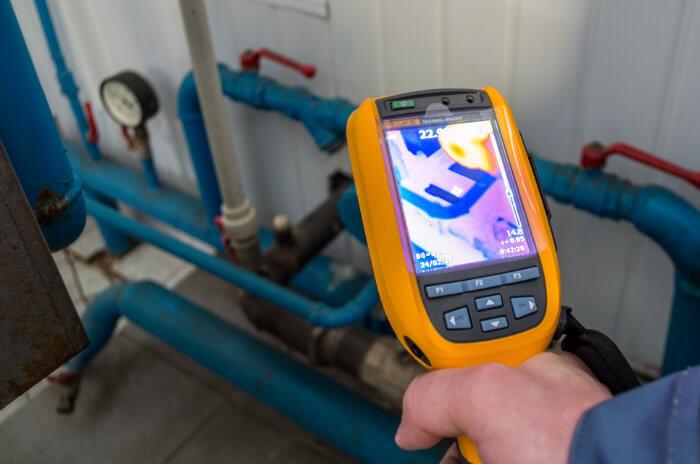
- Use of non-invasive thermal imaging and acoustic technology to minimise damage.
- Detailed moisture mapping to define the full extent of water ingress.
- Explicit confirmation of the leak's origin, essential for trace and access cover.
- Documentation of all works undertaken to locate the leak, forming an audit trail.
How it works
A method, not a guess
01
Establish what is being claimed for
Before equipment comes off the van we ask what has been damaged, when it was first noticed and whether a claim is open. A survey supporting a live claim is scoped differently from one that is purely diagnostic, and it is cheaper to know that at the start.
02
Isolate and eliminate, circuit by circuit
Each supply, heating circuit and waste run is tested separately so that what has been ruled out is as documented as what has been ruled in. Negative results are recorded with the test that produced them, because an adjuster will ask how an area was cleared.
03
Cross confirm before anything is opened
No single method is trusted alone. Acoustic, thermal, tracer gas and moisture readings have to agree on a location before a floor is lifted, which keeps access to one small area and keeps the access line defensible.
04
Record the access as it is taken
What was opened, why it had to be opened and what was found behind it, photographed in sequence at the time. Reinstatement costs get queried when nobody wrote the justification down while the hole was still open.
05
Issue findings a stranger can follow
Cause, origin, method, moisture data, photographs and the limits of what the evidence supports, written for someone who was never in the building.
Six questions a loss adjuster will ask about your leak survey
How was the location established, and by what method?
An adjuster is assessing a finding without having stood in the room. The single most common reason a report generates a request for further information is that it states a conclusion with no method attached to it. A usable survey says which technique produced which finding: acoustic correlation narrowed the run, thermal imaging showed the anomaly here, tracer gas surfaced at this point, moisture readings at these locations confirmed the spread. Before booking, ask any contractor whether their report attributes findings to methods, or whether it simply announces where the leak was. The second kind reads like an opinion, and opinions get queried.
What was ruled out, and how?
Nobody thinks to ask for this until a claim stalls on it. If a survey covers a property and concludes the leak is in the bathroom waste, the obvious next question is what happened to the heating circuits, the incoming main and the cylinder. A file that records each system tested, the test applied and the result is very hard to argue with. A file that mentions only the positive finding leaves an adjuster free to wonder whether anything else was ever checked. Insist that eliminations are recorded, because they cost nothing to write down at the time and are unrecoverable afterwards.
Was the access proportionate to what was known?
Trace and access lines get scrutinised on whether the opening up was reasonable given the information available when it was done. Lifting an entire floor because a ceiling was stained is not proportionate. Lifting two discussions over a run that acoustic and thermal methods both pointed at is. The way to protect that line is to record the state of knowledge at the moment the decision was taken, in writing, with the photographs. This is why we cross confirm with more than one method before anything is opened, and why the justification is written while the hole is still open rather than reconstructed for the invoice.
Do the photographs actually show what the text claims?
Adjusters look at images before they read paragraphs. A photograph of a damp patch proves a damp patch. It does not prove a failed compression joint. The sequence that works shows the area before anything was touched, the access being taken, the failure visible in position, and the affected areas with something in frame for scale. Undated images, or images that could have been taken anywhere, weaken an otherwise sound report. Ask to see a redacted sample before you book so you can judge the photography rather than the promises.
Is the cause specific enough to test against the wording?
Coverage turns on mechanism. Corrosion pinholing a thirty year old run reads differently from a compression fitting that was never tightened properly, and both read differently from a shower tray seal that has failed. A report that says a leak was found under the bathroom gives an insurer no way to apply the wording, so they ask, and the asking is the delay. Naming the mechanism is not about helping or hindering a claim. It is about making the file capable of being decided at all.
Who wrote it, and does it say where the evidence stops?
Counterintuitively, the reports that hold up best are the ones that state their own limits. A document claiming certainty about something it could not have established invites doubt about everything else in it. If a screeded circuit could not be fully tested without a drain down, or if the origin is narrowed to a run rather than a point, saying so is what makes the rest of the document credible. Be wary of any contractor whose reports never contain a qualification, and of anyone who tells you a report guarantees payment. It cannot, and the claim is your insurer's to decide.
Compare like for like
One leak, four invoice lines, three different outcomes
A hidden leak does not produce a bill. It produces four of them: finding the water, reaching it, mending the pipe and repairing what the water ruined. They are covered differently, priced differently and assessed differently, and almost every delayed settlement we see comes from a file in which they were never told apart.
| What to check | A one line invoice | A detection only firm | Emergency Leak Detection 247 |
|---|---|---|---|
| How the work is itemised | One figure. An insurer cannot pay the covered part of a line that also contains an uncovered part, so the whole thing is queried. | A clean detection fee, then someone else's repair invoice written in different language about the same failure. | Detection, access, repair and reinstatement on four lines, described consistently, so each can be sent to whoever is actually carrying it. |
| Cause stated as a mechanism | A location and nothing else, which gives an insurer no way to apply the wording. | Usually a location and a method, which is better and still stops short of naming the failure. | Corrosion, a joint that was never made properly, a failed seal, a nail through a pipe. Coverage turns on mechanism, so the mechanism is named. |
| Record of eliminations | None. | Partial, and rarely with the test attached to each negative result. | Every system tested, the test applied and the result, including everything that held, because that record is unrecoverable once the van has gone. |
| Proportionality of the access | Undocumented, which is the weakest point in most trace and access lines. | Not their decision, so nothing is recorded about the state of knowledge when the floor was opened. | Two methods have to agree before anything is opened, and the reasoning is written with the photographs while the opening is still visible. |
| Photographic sequence | A picture of a damp patch, which proves a damp patch. | Images of the equipment in use, which prove the equipment was used. | Before access, access being taken, the failure visible in position, and the affected areas with something in frame for scale, all timed and placed. |
| Boiler eliminated before the survey | Not considered, so a sealed system fault gets surveyed as a building leak. | Sometimes. | How the boiler behaves is asked about on the call, and the expansion vessel is eliminated early, because a vessel fault is not an escape of water at all. |
| What the report claims | Certainty, with no qualifications anywhere in it. | Certainty about the method used and silence about everything else. | It says where the evidence stops. A report cannot guarantee payment, the decision is your insurer's, and a document that pretends otherwise damages the file it is in. |
What claimants ask
The questions policyholders and agents ask most
Look at how insurance and property questions about leaks are discussed publicly and they sort themselves into a handful of repeating arguments. Almost none of them are about technology. They are about who pays, what the paperwork had to show, and what nobody wrote down at the time.
Threads where the claim stalled on the paperwork, not the plumbing
A recurring shape on the insurance discussions: the leak was found, the repair was done, and then the claim sat for weeks while the insurer asked for information nobody had captured. Posters describe being asked for the detection method, moisture readings or photographs of the access that were never taken because at the time the job felt finished. Our take is that the cost of recording all of that during the visit is roughly zero, and the cost of not having it is measured in weeks. Ask before booking whether findings are attributed to methods or simply asserted.
Confusion over what trace and access actually is
People arrive on these discussions believing trace and access is a standalone benefit that pays for leak detection whenever they want it. The replies usually correct two things: it normally attaches to an insured escape of water that has caused damage, and it does not generally pay to replace the failed pipe. Our take is that both points are in your own schedule and take two minutes to check. Reading them before commissioning a survey changes what you instruct and sometimes whether you claim at all.
Disputes about whether the survey was thorough enough
A pattern of posts where a homeowner is told a property was surveyed, the leak reappears, and it turns out an entire system was never tested. The public discussion advice that emerges is to ask what was eliminated, not just what was found. Our take is the same, which is why per circuit testing is logged with the result rather than summarised. A record of eliminations is what makes a negative finding usable, and it is the part almost nobody asks for until they need it.
Quotes that vary by an order of magnitude for the same job
Cost discussions regularly show quotes for one suspected leak ranging from under a hundred pounds to four figures, which broadly matches the spread Checkatrade publishes for UK leak detection, from £80 to £1,600 with an average around £162. Regulars point out that the cheapest attendance is often the one that finds nothing and recommends a second survey. Our take is to compare confirmed total fees for a defined multi method survey rather than headline hourly rates, because a fixed figure is the only one you can hold anyone to.
Boiler pressure loss with no leak anywhere to be found
One of the most durable discussions on the DIY discussions involves a sealed system losing pressure while detection finds nothing, because the fault is inside the boiler rather than in the pipework. Regulars now routinely tell posters to have the expansion vessel checked before paying for a survey. Our take is that a competent survey eliminates the boiler and tests each circuit separately at the outset precisely to catch this, and that a contractor quoting for whole property detection without asking how the boiler behaves is guessing.
Questions
Asked before every booking
What makes a survey claim grade rather than just accurate?
Traceability. An accurate survey tells you where the leak is. A claim grade one shows how that was established, what else was tested and cleared, what was opened and why, and what the moisture readings were at identified points. The finding is the same. The difference is whether it can be verified by someone who was not there, which is the only test that matters once a file leaves your hands.
I am not claiming. Is the full report worth paying for?
Often not, and we will say so. If you want a dripping joint found and fixed, you need a location and a repair, not a dossier. Where it does earn its place is when damage has occurred and you may claim later, when a neighbour or freeholder disputes the source, or when you are buying or selling and need the history documented. Ask us on the phone and we will give you a straight answer.
What happens if you cannot find it?
The detection fee is waived, and you still receive what was tested and eliminated. That document has real value: it is what rules out an escape of water and redirects the investigation towards condensation, a roof or gutter defect, a failed seal or a boiler losing pressure internally. Several claims each year are resolved by proving the plumbing was not the cause.
Can the report be addressed to my insurer or adjuster?
Yes, and we will address it to whoever needs to read it, including a managing agent or a solicitor in a liability dispute. That does not make us their agent. We are a detection and reporting contractor, our findings do not shift according to who receives them, and we will not characterise coverage, because coverage is a matter for your wording and your insurer.
How quickly do you issue findings after the visit?
Written findings normally follow within 48 hours of attendance, and the engineer will tell you the location and the likely repair before leaving site. Where a second visit is needed, for example because a screeded circuit has to be drained down and given time, we say so on the day rather than issuing a conclusion the data does not carry.
Do you survey before a purchase or at the end of a tenancy?
Yes, and these are worth commissioning deliberately rather than reactively. A pre purchase moisture and pipework survey establishes the condition of a property on a dated record, which matters if a defect surfaces afterwards and somebody argues about when it began. End of tenancy surveys serve the same function in reverse. Neither is an insurance claim, but both produce the kind of dated baseline that makes a future claim straightforward instead of contested.
Will you liaise with my loss adjuster directly?
We will answer technical questions about our own findings, in writing, addressed to whoever you ask us to address them to. What we will not do is negotiate the claim, characterise coverage or represent your interests in the settlement, because none of those are things a detection contractor is regulated to do. If a query is about methodology or what a reading means, send it to us. If it is about whether the policy responds, that is between you and your insurer.
What should a leak detection report contain for an insurance claim?
At minimum: the mechanism of failure, its physical location referenced to something a stranger can find, the detection methods used and which finding each produced, moisture readings taken at identified points, dated photographs covering the area before access, the access itself and the failure in position, a record of what was tested and eliminated, and an explicit statement of what the evidence does not establish. A document with those elements can be assessed on paper. One without them generates questions, and questions are what turn a four week settlement into a twelve week one.
How much does leak detection cost in London?
Checkatrade's published cost guide puts UK leak detection at an average of around £162 per job, with a typical range of £115 to £234, a full spread of £80 to £1,600 once genuinely hard to trace work is included, and hourly rates of £95 to £145. Those are their national figures rather than ours or London specific. What sets an individual fee is the number of circuits to eliminate, the floor construction, whether the leak is live, the attendance window and whether the output has to support a claim. We confirm the exact figure before anyone travels.
Is a leak detection survey covered by my home insurance?
Frequently, through a trace and access extension in the buildings section, which carries its own limit printed in your schedule. It is generally written to meet the cost of finding the leak and of opening up and making good to reach it, and it normally attaches only where an insured escape of water has caused damage. Read your own wording for the limit and the excess, and ask your insurer whether they require pre authorisation before you instruct a contractor.
Can a hidden leak be found without lifting floors?
Usually the location can, and that is the point of surveying before opening. Acoustic equipment listens for escaping water, thermal imaging maps temperature anomalies around heated pipework, tracer gas travels up through screed and tile to a detector, moisture meters map the spread, and per circuit pressure testing narrows which system is losing. Something normally still has to be opened to reach and repair the failure, but the difference between an informed opening and a speculative one is the difference between one small area and several.
How long does a leak detection survey take?
Two to four hours covers most London domestic properties. A single circuit failing a pressure test with a clear acoustic signal resolves faster. Screeded floors, underfloor heating loops and long external supply runs can take a full day, because circuits have to be drained and tracer gas needs time to travel. Where a second visit is genuinely required we say so on the day rather than issuing a conclusion the readings do not support.
What if the survey proves there is no plumbing leak at all?
That is a legitimate and often valuable result. Condensation, a roof or gutter defect, penetrating damp, a failed seal or a boiler losing pressure through its own expansion vessel all mimic a pipe leak. A documented set of eliminations is what redirects the investigation and stops a claim being built on the wrong premise. Where we attend a confirmed live leak and cannot locate it, the detection fee is waived and you still receive the record of what was tested.
London-wide
Covering all 33 boroughs
Related services
Acoustic Detection
Ground microphones and correlators trace pressurised mains leaks in London by sound alone.
Learn moreThermal Imaging
Infrared surveys map wet floors, heating runs and moisture spread across London properties.
Learn moreTrace & Access
Trace and access documented the way UK loss adjusters expect: cause, precise origin, affected areas and the reasoning behind every step we took.
Learn moreWater going somewhere it shouldn’t?
Tell us the symptoms and your postcode. We’ll confirm the visit, the fixed detection fee and the arrival window before you commit to anything.
Book a detection visit