Insurance-Compliant Commercial Leak Detection
Commercial Leak Detection London
In a commercial building, the hard question is rarely where the water came from. It is whose it was. A leak that crosses a demise boundary puts a landlord, a tenant, a managing agent and frequently two separate insurers into the same conversation, and every one of them is waiting on the same single finding before anyone will authorise a repair.
How a commercial survey is apportioned
| Invoice line | How it is treated | When it is settled |
|---|---|---|
| Establishing which side of the demise the failure sits | Decides which policy the whole file goes to | Before equipment leaves the van |
| Survey across common parts and risers | Block policy line where the block wording responds | Booked around occupier access |
| Survey inside a let unit | Often the occupier's own contents or fit out cover | Quoted to whoever instructs us |
| Report copies for managing agent and insurer | Included, addressed so it can be forwarded unaltered | Issued with the survey |
| Opening up through finishes and ceilings | Access line, apportioned with the demise in mind | Scoped once the location is fixed |
Fee basis, not a quote, and not a statement of what your own policy covers. Our detection figure is fixed and confirmed in writing before anyone travels.
That finding is what we produce. Origin pinned to a specific demise or to communal plant, described precisely enough to be recharged, apportioned or recovered against. On full repairing and insuring terms the tenant may be funding the premium and carrying the reinstatement obligation while the landlord holds the policy, so the distinction between communal riser and private pipework decides who is out of pocket.
We survey offices, retail units, restaurants, warehouses and mixed use blocks across London, including occupied premises where trading cannot stop. Out of hours attendance exists for exactly that reason, and evidence of when a loss began and how long premises were unusable is frequently needed for a business interruption element that sits alongside the material damage claim.
Our pricing is structured to reflect the comprehensive, evidence-focused nature of the investigation required for insurance purposes. We provide clear, upfront quotations based on the commercial property's scale and the suspected leak complexity.
What you get
- Comprehensive Leak Location Reports: Detailed documentation of the leak's source and path, formatted for insurer submission.
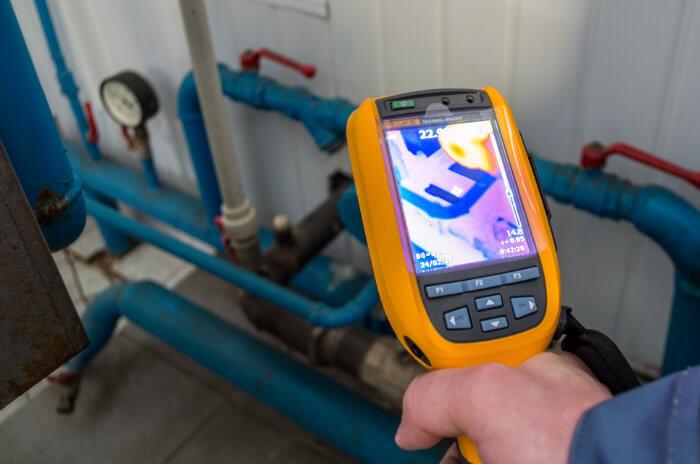
- Non-Invasive Investigation First: We prioritise methods like thermal imaging and acoustic detection to minimise damage and claim complexity.
- Precise Cause Identification: We determine whether the leak originates from plumbing, drainage, roofing, or building fabric, crucial for claim validation.
- Moisture Mapping & Extent Documentation: Visual evidence of the leak's spread to establish the full scope of required repairs.
- Compliance with Insurer 'Trace & Access' Clauses: Our methodology aligns with standard policy requirements for uncovering concealed leaks.
- Expert Witness-Level Documentation: Photographic, video, and sensor data compiled into a clear, professional evidence package.
How it works
A method, not a guess
01
Establish the demise and the reporting line
Before the survey, who holds the buildings policy, who manages the building, and who is entitled to instruct and receive the report. In a multi let building, addressing findings to the wrong party creates a data problem as well as a delay.
02
Work around trading, not through it
Survey windows outside trading hours, plant rooms and risers accessed with the agent, and a plan for which areas can be opened without closing a unit. Business interruption is usually the expensive part of a commercial loss, so avoiding it is part of the job.
03
Test communal and demised systems separately
Risers, boosted mains, plant, and each tenant's own pipework isolated and tested on its own. The point is to be able to say which system failed, not merely where the water surfaced, because water surfaces well away from where it escaped.
04
Document to a recharge standard
Findings written so a managing agent can apportion cost, a landlord can recharge under the lease, or an insurer can pursue recovery against a third party. That means origin, mechanism, method, dated photographs and an explicit statement of what the evidence does not establish.
05
Record the loss timeline
When the escape is likely to have begun, when it was discovered, when it was isolated and which areas were unusable for how long. Where a business interruption element is claimed, that timeline is the evidence it rests on.
Six things to establish before a commercial leak survey
Work out whose demise the water is in
In a multi let building the expensive question is ownership, not location. Communal riser or private pipework, landlord's plant or tenant's installation, above the ceiling line or below the floor of the unit above. That determination decides who instructs the repair, which policy responds and whether costs get recharged through the service charge. It is a factual finding about pipework, which means it can be established by survey rather than argued about, and establishing it early is what stops three parties each waiting for one of the others to move.
Check whether the lease or the policy drives the answer
On full repairing and insuring terms the tenant is frequently paying the insurance premium and carrying the reinstatement obligation while the landlord holds the policy. That arrangement can mean the party who suffers the loss is not the party who claims for it. Before commissioning anything, establish who is the insured, who is entitled to instruct, and who the report should be addressed to. Addressing findings to the wrong party in a multi let building creates a delay and, where other tenants are involved, a data handling problem as well.
Price the downtime, not just the survey
In retail, hospitality and anything customer facing, the survey fee is usually a small fraction of what a day of closure costs. That changes the arithmetic on out of hours attendance, which is frequently the cheaper option overall despite the uplift, and on phased access planning that keeps a unit trading while work proceeds. Decide this deliberately at the booking stage. It is the one variable where paying more for the survey reliably reduces the total cost of the incident.
Record the loss timeline from the start
Where a business interruption element is claimed, it rests on dates and durations: when the escape is likely to have begun, when it was discovered, when it was isolated, and which areas were unusable for how long. That information is easy to capture as events happen and close to impossible to reconstruct convincingly afterwards. Keep a simple dated log from the first report, including who was notified and when, because notification timing is regularly disputed in multi party losses.
Arrange access to plant and risers before the engineer arrives
The commonest cause of an abandoned commercial survey is a locked plant room and nobody on site with a key. Before the visit, confirm who can open risers, plant rooms, roof spaces and neighbouring demises, and whether entry to another tenant's unit needs notice under their lease. Bring out any drawings or service layouts that exist, even old ones. A survey that can move through a building without waiting is often half the length of one that cannot.
Decide in advance what the report has to be capable of
A report that merely locates a leak is enough to get a repair started. A report that has to support a recharge under a lease, an apportionment between tenants, or a recovery against a third party's insurer needs to be written to a different standard: mechanism, origin tied to a demise, method attribution, dated photography and an explicit statement of what the evidence does not reach. Tell the contractor which of these you need at booking, because the second cannot reliably be reconstructed from the first.
Compare like for like
Which side of the demise the water came from
In a managed or commercial building the question of who pays usually arrives before the question of where the water is. A demised pipe, a common part and a tenant's own fit out sit under different policies and different obligations. A survey that will not say which side of the line the failure falls on has moved the argument on without resolving it.
| What to check | A one line invoice | A domestic only firm | Emergency Leak Detection 247 |
|---|---|---|---|
| The demise addressed directly | Not addressed, so the report cannot be used to route the cost anywhere. | Outside their experience. A residential survey format has no concept of a demise. | The report states which side of the demise the failure sits on and what it relied on to reach that, since that determines which policy the file goes to. |
| Written for a managing agent | Written for whoever opened the door. | Written for a homeowner, which is the wrong register and the wrong detail. | Formatted so it can be forwarded unaltered to an agent, a freeholder and a block insurer without a covering explanation from you. |
| Access across occupied units | Handled by turning up and hoping. | Not planned for, so the survey stops at the first locked door and returns as a second chargeable visit. | Access is sequenced with the agent before attendance, and units that could not be entered are listed in the report so the gap is visible rather than silent. |
| Working around trading hours | Whenever the van is free. | Daytime only, which is exactly when a commercial tenant cannot afford the disruption. | Surveys booked outside trading hours where the building needs it, with the out of hours element shown as its own figure. |
| Concrete frame and riser work | Approached as if it were a house, with the same assumptions about where water travels. | Unfamiliar. Water in a concrete frame surfaces a long way from where it left the pipe. | Risers and slab penetrations are surveyed as routes rather than as locations, because the visible damage in a frame building is rarely above the failure. |
| Interruption to the business | Not considered in the method or the timing. | Not considered. | Business interruption exposure is treated as part of the brief, so the survey sequence is built around keeping the building trading. |
| How it is invoiced | One figure, which an agent cannot recharge and an insurer cannot part settle. | A domestic style figure that does not map onto a service charge or a block policy. | Detection, access, repair and reinstatement separated, and where appropriate apportioned by demise, so the agent can recharge and the insurer can pay what it covers. |
What claimants ask
The questions policyholders and agents ask most
Commercial leak discussions sit on the property management, landlord and business discussions rather than the DIY ones, and the argument is nearly always the same: three parties, two insurers and one unanswered question about whose pipe it was.
Nobody willing to instruct because nobody knows whose it is
The defining commercial thread: water is crossing between units, the tenant says landlord, the landlord says tenant, the agent waits for instruction, and the damage continues while everyone is right to be cautious. The advice that emerges is to get the origin established independently and quickly. Our take is that whose pipe it is happens to be a factual question about pipework, which means it can be surveyed rather than argued, and doing that early is almost always cheaper than the delay.
Full repairing and insuring terms producing counterintuitive outcomes
Posts from commercial tenants discovering they are funding the premium and carrying the reinstatement obligation while the landlord holds the policy and controls the claim. Replies point out that this is a normal feature of FRI leases rather than an error. Our take is to establish who is the insured and who may instruct before commissioning anything, because a report addressed to the wrong party in a multi let building creates both delay and a data handling problem.
Business interruption claims with no usable timeline
A recurring frustration: the material damage claim proceeds and the interruption element stalls because nobody recorded when the loss began, when it was discovered, and which areas were unusable for how long. Board advice is to keep a dated log from the first report. Our take is that this information is trivial to capture as events happen and close to impossible to reconstruct convincingly afterwards, which is why we record the loss timeline as part of the survey.
Surveys abandoned because nobody had a key
A mundane but expensive pattern: an engineer attends a commercial building and cannot reach the riser, the plant room or the unit above. Agents on these discussions describe repeat visits billed for access that should have been arranged once. Our take is that confirming who can open what, and what notice another tenant's lease requires, is a ten minute job before the visit that routinely saves two further attendances.
Reports that could not support a recharge
Threads where a managing agent holds a report saying a leak was found, and needs one saying which demise it originated in, because the first cannot support an apportionment or a recovery. Our take is that the two documents come from the same visit but not from the same instruction, so say at booking what the report has to be capable of. The recharge standard cannot reliably be reconstructed from a report that was only ever written to get a repair started.
Questions
Asked before every booking
Water is coming into my unit from the floor above. Who commissions the survey?
Usually the managing agent or the landlord, because the origin may be in communal pipework and access to the premises above is needed either way. Notify the agent in writing immediately and ask them to instruct. If they are slow and damage is ongoing, a tenant can commission an independent survey to establish the source, and that report is then what everyone else acts on. Keep the notification correspondence, because delay is regularly argued about afterwards.
Can your report be used to recharge another party?
It can support a recharge, and it is written with that in mind. What it contains is findings of fact: which system failed, where, by what method that was determined, and what the evidence does not reach. Whether the lease or the policy permits a recharge or a recovery is a legal and coverage question for the agent, the solicitor or the insurer. We supply the technical basis, not the determination.
How is this different from a domestic survey?
Three things. The systems are larger and often include boosted mains, plant and long horizontal runs, so isolation strategy matters more. The reporting has to identify a demise rather than just a room. And the constraint is trading, not convenience, which is why most commercial surveys are scheduled outside opening hours and why a phased plan agreed in advance beats an open ended visit.
Do you attend out of hours for commercial premises?
Yes. Overnight and weekend attendance is available and the applicable rate is stated when you book, as an exact figure rather than a multiplier applied afterwards. For occupied retail and hospitality premises this is normally the sensible option, because the cost of the uplift is usually a fraction of the cost of closing for a day.
What do you need from the managing agent before attending?
Access to plant rooms and risers, a point of contact who can authorise entry to other demises, any drawings or service layouts that exist, and confirmation of who the report should be addressed to. Where a claim is open, the reference and the adjuster's details as well. Having these ready is routinely the difference between one visit and three.
Who is responsible for a leak between commercial units?
Responsibility follows the origin and then the lease. Pipework serving the building generally sits with the landlord or the management company and is funded through the service charge, while an installation within a demise is usually the tenant's. On full repairing and insuring terms the allocation can be less intuitive than it looks, since the tenant may carry the reinstatement obligation while the landlord holds the policy. A survey establishes where the failure was. The lease determines what follows from that, which is a matter for the agent or a solicitor.
Can a commercial leak survey be done without closing the premises?
Usually, yes, and it is normally the cheaper approach overall. Non invasive methods can run during trading hours in most environments, with plant rooms, risers and any opening up scheduled outside them. Where a unit does have to be closed, phasing the work so only part of the floor area is affected at a time is often possible. Tell us at booking what cannot be interrupted and the survey is planned around it rather than through it.
What evidence does a business interruption claim need about a leak?
Primarily a timeline and a causal link: when the escape began so far as it can be established, when it was discovered and isolated, what was damaged, and which areas were unusable for how long. A detection report supplies the technical half, the mechanism and origin and the evidence for when the loss is likely to have started. The financial half comes from your own records. Keeping a dated log from the first report is what makes the two halves fit together at settlement.
Do you attend commercial premises out of hours?
Yes. Overnight and weekend attendance is available across London and the applicable rate is stated as an exact figure when you book rather than applied afterwards as a multiplier. For occupied retail, hospitality and office premises this is usually the sensible choice, because the uplift is generally a small fraction of the cost of losing a trading day.
How do commercial leak surveys differ from domestic ones?
The systems are larger and often include boosted mains, plant and long horizontal distribution, so isolation strategy matters more and testing has to separate communal systems from demised ones. The reporting has to identify a demise rather than just a room, because the finding is what drives recharge and apportionment. And the binding constraint is trading rather than convenience, which is why most commercial work is scheduled around opening hours and planned in phases agreed in advance.
What should a managing agent have ready before the survey?
Access to plant rooms, risers and roof areas, a contact who can authorise entry to other demises and give any notice the leases require, whatever drawings or service layouts exist, and confirmation of who the report is to be addressed to. If a claim is already open, the reference and the loss adjuster's details as well. Having these in place is routinely the difference between resolving a building in one visit and spreading it across three.
London-wide
Covering all 33 boroughs
Related services
Trace & Access
Trace and access documented the way UK loss adjusters expect: cause, precise origin, affected areas and the reasoning behind every step we took.
Learn moreUnderground Leaks
Supply pipe and mains leaks located under London gardens, drives and concrete.
Learn moreLeak Detection
Hidden leak in a London property? We locate it without demolition, then set out cause, origin and damage in a trace and access report for your insurer.
Learn moreWater going somewhere it shouldn’t?
Tell us the symptoms and your postcode. We’ll confirm the visit, the fixed detection fee and the arrival window before you commit to anything.
Book a detection visit