Low Water Pressure in the House: Causes and What to Do
Most low pressure complaints are actually low flow, and the two have different causes and different fixes. How to tell them apart, where the restriction usually is, and the cases where a pressure drop is the first sign of a leak.
Low water pressure is one of those complaints where the words people use and the problem they have rarely match. Almost every household report of low pressure is in fact a report of low flow: the shower is feeble, the bath takes too long, the kitchen tap dribbles when the washing machine is running. Pressure and flow are different quantities with different causes, and the first useful step is working out which one has actually changed.
This guide separates the two, shows how to narrow the fault down to one outlet or the whole property in about ten minutes, sets out the causes that are common in London housing stock, and covers the case this site cares about most: when a pressure drop is the first visible sign of a leak.
Pressure and Flow Are Not the Same Thing
Pressure is the force pushing the water. Flow is the volume that actually arrives per minute. You can have good pressure and poor flow, which is what a partially blocked pipe or a scaled aerator produces, and you can have generous flow at low pressure, which is what a gravity fed tank on the floor above produces at a ground floor tap.
What each one means in practice
| Symptom | Usually means | Where to look |
|---|---|---|
| Weak at one tap, fine elsewhere | A restriction at that outlet | Aerator, cartridge, flexible tail, isolating valve |
| Weak everywhere, all the time | A whole property issue | Stop tap, supply pipe, incoming main, or a filter |
| Weak only when something else runs | Insufficient flow rather than insufficient pressure | Pipe diameter, scale, shared supply |
| Weak only at certain times of day | Network demand or shared supply competition | Neighbours, the local main, a shared pipe |
| Weak only upstairs | Head, not pressure loss | The type of system you have |
| Recently and suddenly weak, no other change | Something has changed physically | Stop tap position, a leak, a valve, a failed component |
How to measure both at home in ten minutes
Flow is easy to measure and worth knowing before you call anyone. Turn everything else off, run the ground floor kitchen cold tap fully open into a measuring jug or a bucket of known volume, and time it. Ofwat's published guidance on water pressure sets the reference level of service as a minimum of seven metres static head in the communication pipe serving the property, which corresponds to a flow of at least nine litres per minute at the ground floor kitchen cold tap with everything else turned off. That is a floor, not a target, and a comfortable modern shower wants considerably more.
Pressure itself needs a gauge, and an inexpensive screw-on gauge for an outside tap or washing machine connection will tell you far more than any amount of guessing. Take the reading twice: once with nothing running, which gives static pressure, and once with a tap wide open, which gives dynamic pressure. A large gap between the two points at a restriction in the supply rather than a low supply pressure.
Which System Do You Have
Half of all low pressure complaints are explained by the system type alone, and the fixes are completely different.
| System | How to recognise it | Typical pressure behaviour |
|---|---|---|
| Combi boiler, mains fed | No hot water cylinder, no loft tank | Hot and cold both at mains pressure; flow drops sharply when two outlets run together |
| Unvented cylinder, mains fed | Insulated cylinder with an expansion vessel and pressure relief pipework | Strong hot and cold, but performance depends on incoming mains flow |
| Gravity fed, tank in the loft | Cold water storage cistern in the loft, vented copper cylinder | Cold at the kitchen is mains pressure; everything else depends on the height of the tank above the outlet |
| Gravity with a pump | As above plus a shower or whole house pump | Good until the pump fails or the tank runs low |
On a gravity system, a shower on the top floor sits close to the tank and therefore has very little head above it, which is why it is usually the weakest outlet in the house. Nothing is wrong. That is how the system works, and the fix is a pump or a change of system rather than a search for a fault.
Whole House or One Outlet
This single split does most of the diagnostic work. Test the ground floor kitchen cold tap first, because it is almost always taken directly off the incoming main and is therefore the truest measure of what is arriving at the property.
| Test | Result | What it points to |
|---|---|---|
| Kitchen cold tap | Weak | A supply side problem: stop tap, supply pipe, main, filter or a leak |
| Kitchen cold tap | Strong, but other outlets weak | Internal distribution, scale, or the system type |
| Hot only weak | Everywhere | Cylinder, expansion vessel, heat exchanger or scale in the hot side |
| Cold only weak | Upstairs | Tank level, tank outlet valve, or a blocked tank feed |
| One tap weak, hot and cold | Localised | Aerator, cartridge, flexible tail or its isolating valve |
| Everything weak only at peak times | Intermittent | Network demand, or competition on a shared supply pipe |
The single outlet checklist
- Unscrew the aerator at the spout and clean or replace it. In hard water areas this alone fixes a large proportion of single tap complaints.
- Check the small isolating valve under the basin or sink. These are frequently left part closed after other work, and they seize part open.
- Look at the flexible tails. The bore inside a flexible connector is much narrower than the pipe, and they scale, kink and collapse internally where nothing is visible outside.
- On a mixer, suspect the cartridge, which silts up and restricts one side before the other.
- On a thermostatic shower, suspect the cartridge and the filters in its inlets, which are designed to collect debris and are rarely cleaned.
The Common Causes in London Homes
Old pipework, narrow bore and scale
London sits in a hard water area, and the effect on flow accumulates for years before anyone notices. Scale narrows the effective bore of a pipe, coats heat exchangers and cylinders, and collects at every restriction, which is why hot side flow usually degrades before cold. Older properties compound it: galvanised steel corrodes internally and closes up, lead supply pipes are often smaller in bore than a modern replacement, and a half inch imperial run feeding a modern bathroom was never sized for it. Our notes on hard water and limescale in London homes and on lead, galvanised and copper pipework in London homes cover both.
Stop taps and valves that are not fully open
The single most common and most embarrassing cause. An internal stop tap left a turn or two short of fully open after a repair restricts the whole property, and nobody thinks to check it because nothing visible has changed. The same applies to the external boundary valve and to service valves on individual runs. Before anything else, find the internal stop tap, close it fully, then open it fully and back off a quarter turn. If the stop tap will not move or leaks when handled, our note on a leaking or seized stopcock covers the options.
Shared supplies, demand and the height of the property
A shared supply pipe serving several converted flats means everybody is drawing from one pipe, and the effect shows at breakfast and in the early evening rather than at three in the afternoon. Height matters too: on a mains fed system the pressure available at a top floor flat is lower than at street level simply because the water has to be lifted there. Neither is a fault, and both are worth establishing early because they change what the realistic fix is.
Pressure reducing valves, filters and softeners
Equipment installed for good reasons restricts flow when it is neglected. A pressure reducing valve fitted to protect an unvented system drifts downwards as it ages. Inline filters and scale reducers block. Water softeners restrict when the resin bed channels or the unit stops regenerating. Anything fitted between the incoming main and the house is worth identifying and testing across before the pipework is blamed.
When Low Pressure Means a Leak
A leak diverts water before it reaches the tap, so a substantial one can reduce pressure and flow at every outlet in the property at once. This is the case worth ruling out early, because it is the only one on the list that is actively causing damage while you investigate.
The checks that separate a leak from a restriction
- Close every outlet in the property, including the toilet fill valves and any outside tap, and read the meter. Leave it untouched for an hour or more with nothing used, then read it again. Movement means water is being lost somewhere past the meter. Our guide to reading your water meter to check for a leak sets out the method.
- Walk the ground outside. A supply pipe crossing a garden or driveway leaks into the ground rather than into the house, so the symptoms are a pressure drop indoors and nothing visible except, sometimes, a patch that stays green or wet in dry weather.
- Check whether the pressure drop appeared suddenly. Scale, corrosion and demand all degrade slowly over years. A change over days points at something physical: a failed component, a valve that has moved, or a leak.
- Listen at the stop tap with everything closed. A persistent hiss or rush with no outlet running is a strong indicator of loss on the supply.
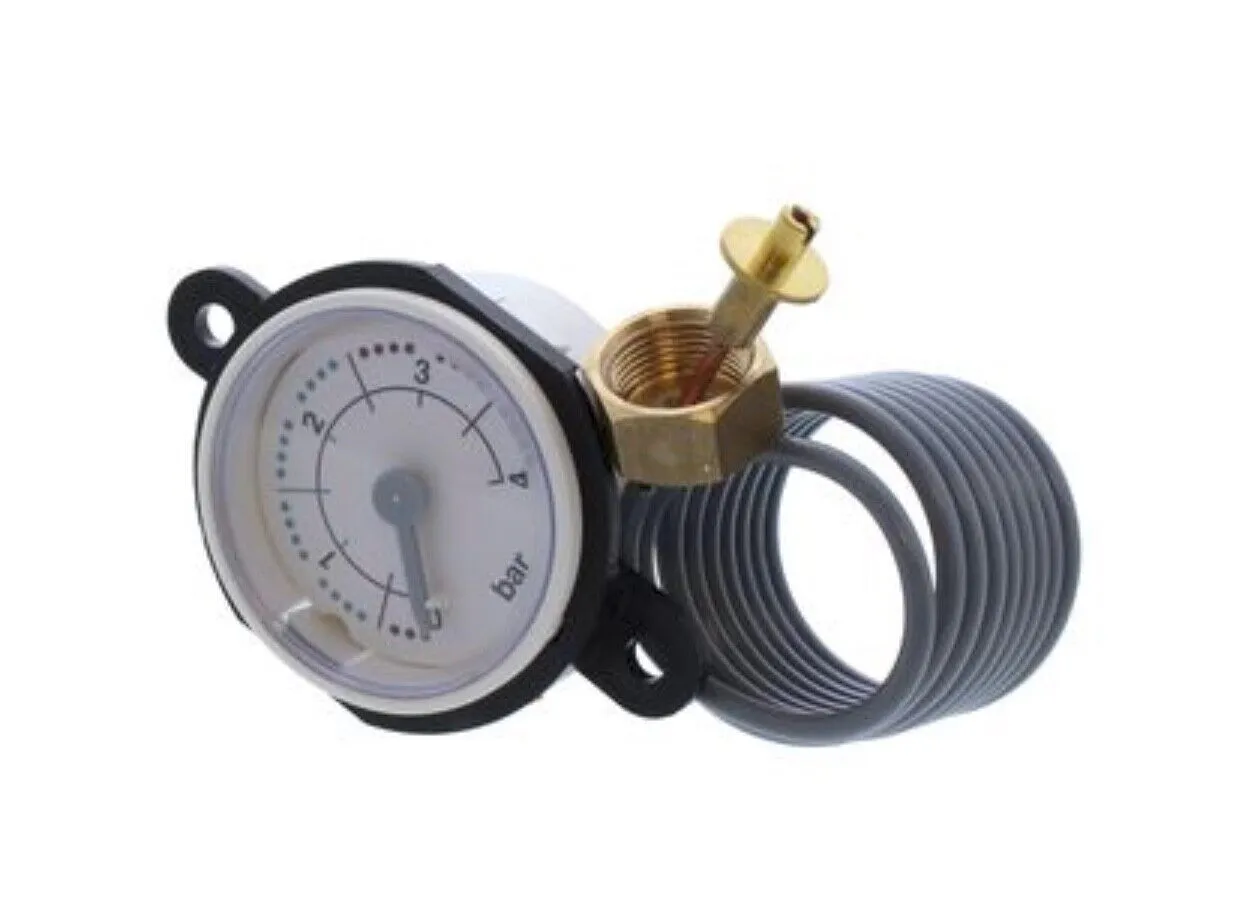
- Check the boiler pressure gauge separately. Heating pressure is a closed system and has nothing to do with tap pressure, but a falling gauge is its own evidence of a leak on the heating circuit.
Where a buried supply pipe is implicated, responsibility for the pipe itself is a separate question and is covered in our guide to who is responsible for an underground supply pipe.
Where the Diagnosis Goes Wrong
Pressure problems attract confident wrong answers because the symptom is so general, and each of the following is a genuinely common dead end.
What a pressure gauge cannot tell you
A gauge reads at one point at one moment. A healthy static reading at an outside tap says nothing about the flow available inside the house, because a restriction downstream will not show on it until water is actually moving. It cannot locate a restriction, only demonstrate that there is one between two points, and it will not distinguish a partly closed valve from a scaled pipe from a leak. Static pressure with everything off can look entirely normal on a property that is losing water underground, because the supply refills the system as fast as the leak empties it.
The three common dead ends
- Fitting a pump to a property with a supply restriction. A pump moves water it can get hold of and cannot create flow that is not arriving. On a mains fed system it can also be prohibited, because drawing directly from the incoming main is restricted under the water fittings regulations.
- Replacing a boiler to fix poor hot water flow. If the incoming main delivers a limited flow, a new combi delivers the same limited flow at a higher price.
- Repiping a bathroom without measuring the incoming supply first. A generous internal installation fed by a narrow or partly blocked supply pipe performs exactly as badly as the one it replaced.
The related error runs the other way, and it is worth mentioning because it costs more. Unusually high pressure is also a problem, and it damages fittings, causes water hammer and shortens the life of flexible connectors. Our note on whether high water pressure is bad covers the symptoms.
What to Do, and in What Order
Work outwards from the cheapest and most reversible checks, and do not let anybody sell you a solution before the measurement has been taken:
- Establish whether it is one outlet or the whole property, using the ground floor kitchen cold tap as the reference.
- Measure the flow at that tap into a container with everything else off, and compare it against the nine litres per minute reference level.
- Check the internal stop tap is fully open, then the external boundary valve, then any service valves.
- Identify anything fitted in line: pressure reducing valve, filter, softener, scale reducer. Test across each one.
- Clean aerators, check isolating valves and inspect flexible tails at any affected outlet.
- Run the meter isolation test. If the meter moves with everything closed, stop diagnosing pressure and start looking for a leak.
- If the flow at the kitchen tap is below the reference level and nothing internal explains it, raise it with your water company, since the reference level of service applies at the communication pipe.
Most low pressure is explained somewhere in that list, and most of it is cheap. The one outcome that changes the urgency is a moving meter, because at that point the question is no longer why the shower is weak but where the water is going.
How we help with this
If the article describes a problem you actually have, these are the visits that deal with it.
- leak detection in London
Finding a hidden leak without opening the property up first.
- acoustic leak detection
Ground microphones and correlators on a pressurised pipe.
- central heating leak detection
For a boiler losing pressure or a circuit that will not hold.
Frequently asked questions
What is the difference between low water pressure and low flow?
Pressure is the force pushing the water, and flow is the volume that actually arrives per minute. You can have perfectly adequate pressure and poor flow, which is what a scaled pipe or a blocked aerator produces, and you can have plenty of flow at low pressure, which is what a loft tank feeding a ground floor tap produces. Almost every household complaint about pressure is really about flow, and the distinction matters because a pump helps one and does nothing for the other.
How much water pressure should I actually have?
Ofwat sets a reference level of service of a minimum seven metres static head in the communication pipe serving the property, which corresponds to at least nine litres per minute at the ground floor kitchen cold tap with everything else turned off. That is a regulatory floor rather than a comfortable target, and a modern shower wants considerably more than nine litres a minute. Measure it with a jug and a timer before calling anyone, because the number changes the conversation completely.
Why is the pressure only bad in the upstairs shower?
Usually because of head rather than a fault. On a gravity fed system the force at any outlet depends on how far it sits below the cold water storage cistern, and a shower on the top floor sits very close to the tank. That is how the system was designed to work. The fixes are a shower pump, an accumulator or a change of system, not a search for a blockage. Check the tank level and its outlet valve first, since both are cheap to rule out.
Can a hidden leak cause low water pressure?
Yes, and it is the one cause worth ruling out first because it is actively doing damage while you investigate. A leak diverts water before it reaches the tap, so a substantial one reduces flow at every outlet at once. Close every outlet including toilet fill valves, read the meter, leave it an hour with nothing used and read it again. Movement means loss somewhere past the meter. A pressure drop that appeared over days rather than years is particularly suspicious.
Will fitting a pump fix my low water pressure?
Only if the water is arriving and the problem is distribution. A pump moves water it can get hold of and cannot create flow that is not reaching the property, so on a supply side restriction it either achieves nothing or makes the noise worse. On a mains fed system, drawing directly from the incoming main with a pump is also restricted under the water fittings regulations. Measure the flow at the ground floor kitchen cold tap before anyone quotes for pumping equipment.
Why did my pressure drop suddenly with no warning?
Because something changed physically, which is useful information. Scale, corrosion and rising local demand all degrade performance slowly over years, so a change over days points elsewhere. The usual candidates are a stop tap or service valve left part closed after other work, a pressure reducing valve or filter that has failed or blocked, a collapsed flexible connector, work on the local main, or a new leak on the supply pipe. Check the valves first, then run the meter test.